The Grid Sets AI's Schedule
In 2026, electricity infrastructure has become the binding constraint on frontier AI deployment. Interconnection queues and state-level utility policy now set the deployment schedule, and the hyperscaler rush into nuclear PPAs is the evidence. Efficiency gains are the standard rebuttal, but grid capacity tracks total demand, and the variable that moves the schedule is capability against electricity.
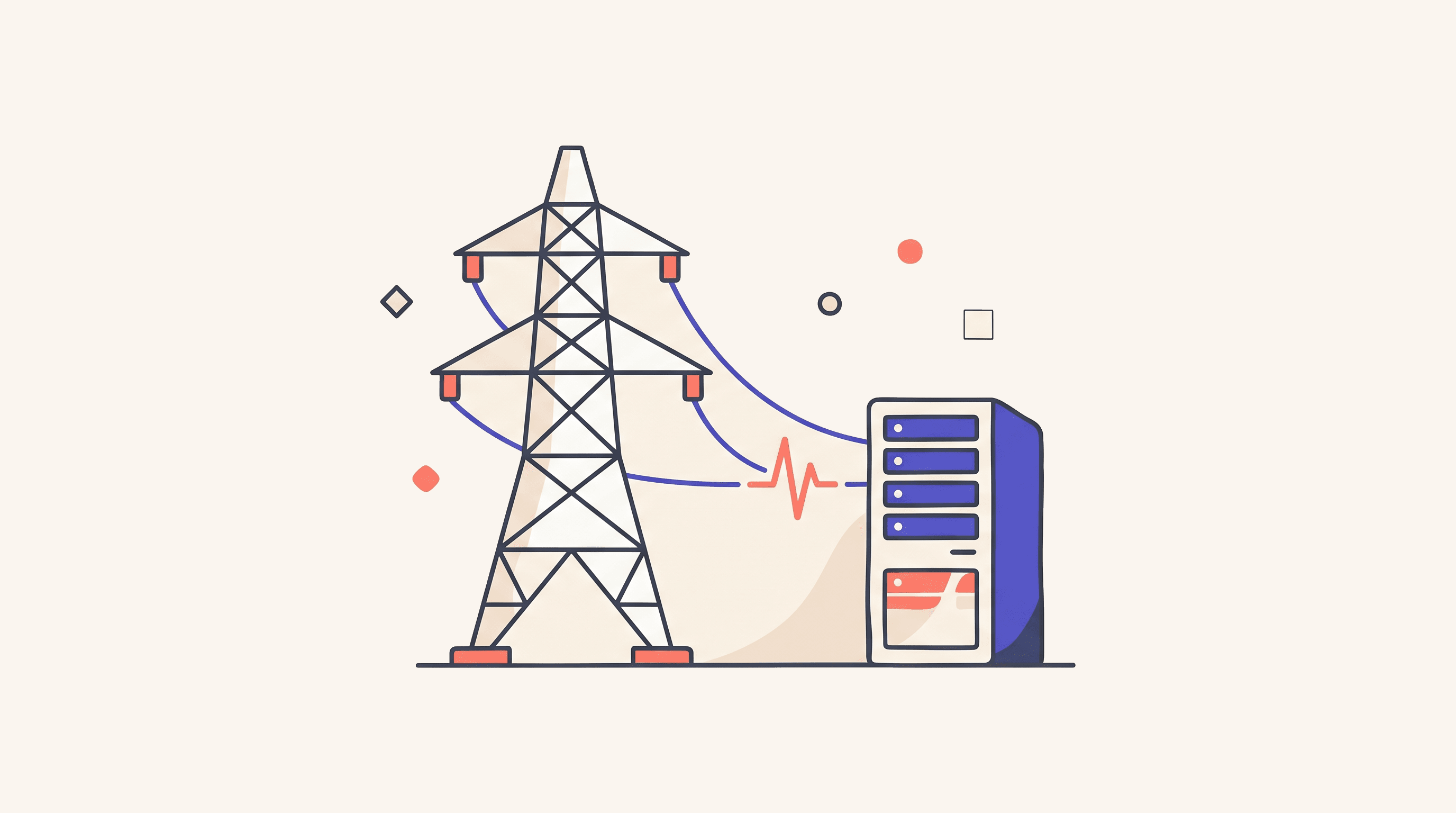
SpaceX's May 2026 S-1 filing disclosed Anthropic's compute deal: $1.25 billion every month through May 2029 for Colossus capacity, about $15 billion a year. The contract reads as a chip-services arrangement on paper. Most of that money buys electricity.
The binding constraint on frontier AI deployment in 2026 has moved off the chip. Chip supply is no longer the question that determines who can ship what, and even talent, which was the binding constraint through most of 2024, has loosened as the pool of trained model engineers has grown. The general "AI is becoming power-bound" thesis has been argued by Aschenbrenner, by energy-industry analysts, and inside OpenAI's own Industrial Policy paper for at least eighteen months. By 2026, the location of the binding constraint has narrowed: power delivery, meaning wires, transformers, interconnection studies, and state-level approval timelines. Power delivery sets the schedule now because it's the only piece of the chain that didn't loosen.
Look at the interconnection queues. ERCOT, the Electric Reliability Council of Texas that runs the state's grid, saw its large-load queue (75 MW or larger) expand nearly 300% year over year, reaching more than 233 GW of capacity requests by the end of 2025. The first quarter of 2026 alone saw 198 GW of new applications, more than 70% from data center developers (Latitude Media).
PJM Interconnection, the grid operator covering the mid-Atlantic data-center belt from Northern Virginia through Ohio, has a sharper version of the same problem. Its 2027 capacity auction fell 6 GW short of reliability targets, the first such failure in PJM's history, and capacity prices hit a record $333.44 per MW-day.
Data centers drive 94% of projected load growth in the region. Between 2026 and 2031, large-load additions hit 35.1 GW while total demand grew only 34.6 GW. Base demand is contracting under the AI surge (Utility Dive on PJM's 2026 Load Forecast Report).
Step back, and the aggregate number lands hardest. As of early 2026, U.S. queues contain about 2,600 gigawatts of proposed generation and storage. Wait times in the busiest regions extend to five years or more, and 60 to 76% of queued projects may never come online (Ascend Analytics). The capacity is theoretically there, but the process to interconnect it isn't keeping up.
That changes what it means to "have access to GPUs." Owning the chip means very little if it can't be plugged in.
Over the last twelve months, every major tech hyperscaler signed at least one nuclear power deal for AI capacity: thirteen announced projects, more than 9.8 GW committed (SMRintel). The four largest deals:
| Hyperscaler | Commitment | Notes |
|---|---|---|
| Microsoft | 835 MW, 20-year PPA, ~$1 billion | Constellation; Three Mile Island restart |
| Amazon | $20B+ converting Susquehanna; $700M into X-energy for 12 SMRs | Largest cash commitment |
| 500 MW from Kairos Power SMRs | Earliest small-modular-focused deal | |
| Meta | 5.2 GW total, 2032-2035 timeline | Largest single commitment, longest timeline |
The deals don't read as ESG positioning so much as supply-chain consolidation. They're buying delivery: physical wires, regulatory certainty, freedom from interconnection-queue politics. The political-risk premium makes the deals expensive.
What the Efficiency Gains Don't Solve
Efficiency makes the standard rebuttal. Anthropic disclosed in Q2 2026 that its compute cost as a share of revenue had fallen from 71 cents to 56 cents in a single quarter (PYMNTS). Model architectures keep getting smaller for equivalent capability, and a given output requires meaningfully less energy than it did six months ago. If efficiency keeps improving at that pace, the grid story might bend with it.
Jevons cuts the other way. Stanford's 2025 AI Index found that the inference cost of a system performing at GPT-3.5 level fell by more than 280x between November 2022 and October 2024. That collapse in unit price didn't reduce total compute spend; it enabled use cases that hadn't been economically viable, and total workload grew faster than the price collapsed.
The IEA already builds continued efficiency gains into its forecast. U.S. data center power demand reaches 260 TWh in 2026 in that forecast, and data centers account for more than 20% of U.S. electricity demand growth through 2030. The growth number assumes the chips and models keep getting more efficient, and still gets to doubling.
Efficiency arguments work for individual chip generations. Grid capacity tracks total demand, and per-task efficiency moves on a different curve.
The Political-Economy Layer
This is where the argument leaves pure engineering territory. Interconnection queues exist because the institutional process for connecting generation to load runs slower than the generation itself shows up. FERC sets the federal rules and state PUCs set the local ones, and both respond to political pressure.
ERCOT's SB6, passed in 2025, addressed large-load interconnection rules by requiring projects to pay a study fee of at least $100,000 and demonstrate site control to secure a queue position. The intent was to filter out speculative applications, and the effect has been to set a floor on who can play. The Texas grid is now structurally easier for Amazon and Microsoft to expand on than for a mid-sized AI company without existing land holdings.
State-level data center power policy will be the load-bearing variable for the next five years of AI deployment in the U.S. Three watch-points:
- PPA terms, specifically the cost-recovery clauses. Are utilities allowed to pass data-center-driven grid upgrades to residential ratepayers, or are they ring-fenced to the data center contracts? Virginia is litigating this right now, and the answer will change the local politics of data center siting across the mid-Atlantic.
- Behind-the-meter buildouts. Amazon's private grids and Meta's on-site generation are both attempts to skip the interconnection queue. State PUCs are starting to push back, particularly when the workaround removes the data center from the rate base entirely.
- Interconnection process reform at the queue level. FERC Order 2023 has been in effect for two years and the queues are still backed up. The next round of reforms will determine whether the 2,600 GW of queued capacity becomes deliverable or stays paper-only.
What This Implies
Deployment teams feel this first. Multi-region splits now sort by power availability rather than redundancy, and the teams that locked in compute through hyperscaler PPAs over the last twelve months are operating with a structural cost and timing advantage that compounds through the rest of this AI cycle.
Hyperscaler balance sheets show the same shift. Of the $300 billion that Microsoft, Google, Amazon, and Meta are projected to spend on AI infrastructure in 2026, the share going to power deals, transmission upgrades, and PPA prepayments has been rising quarter over quarter. The trajectory suggests it crosses the chip-procurement line inside this cycle.
The same variable shows up in the economics literature. Acemoglu's "capability-vs-absorption" framing now depends on physical interconnection timelines as much as firm reorganization speed. The OECD's 2-6% high-intensity adoption number for G7 firms holds partly because the infrastructure to support deeper adoption isn't on the grid yet.
Most AI commentary in 2026 has framed deployment as capability against absorption, but the variable that actually moves the schedule might be capability against electricity. State utility commissions and federal interconnection studies set that timeline. Watch the queue.
Share