Infrastructure Is the Moat
SpaceX's S-1 makes the explicit case that physical infrastructure, not model capability, decides the AI economy, and reframes the company as a vertically integrated compute, networking, and energy platform targeting a $1.75 trillion valuation. The buyer-side implication is structural and immediate: every frontier-AI contract a team signs in 2026 carries a second-order compute-provider exposure that sits inside the vendor risk profile whether anyone priced it or not.
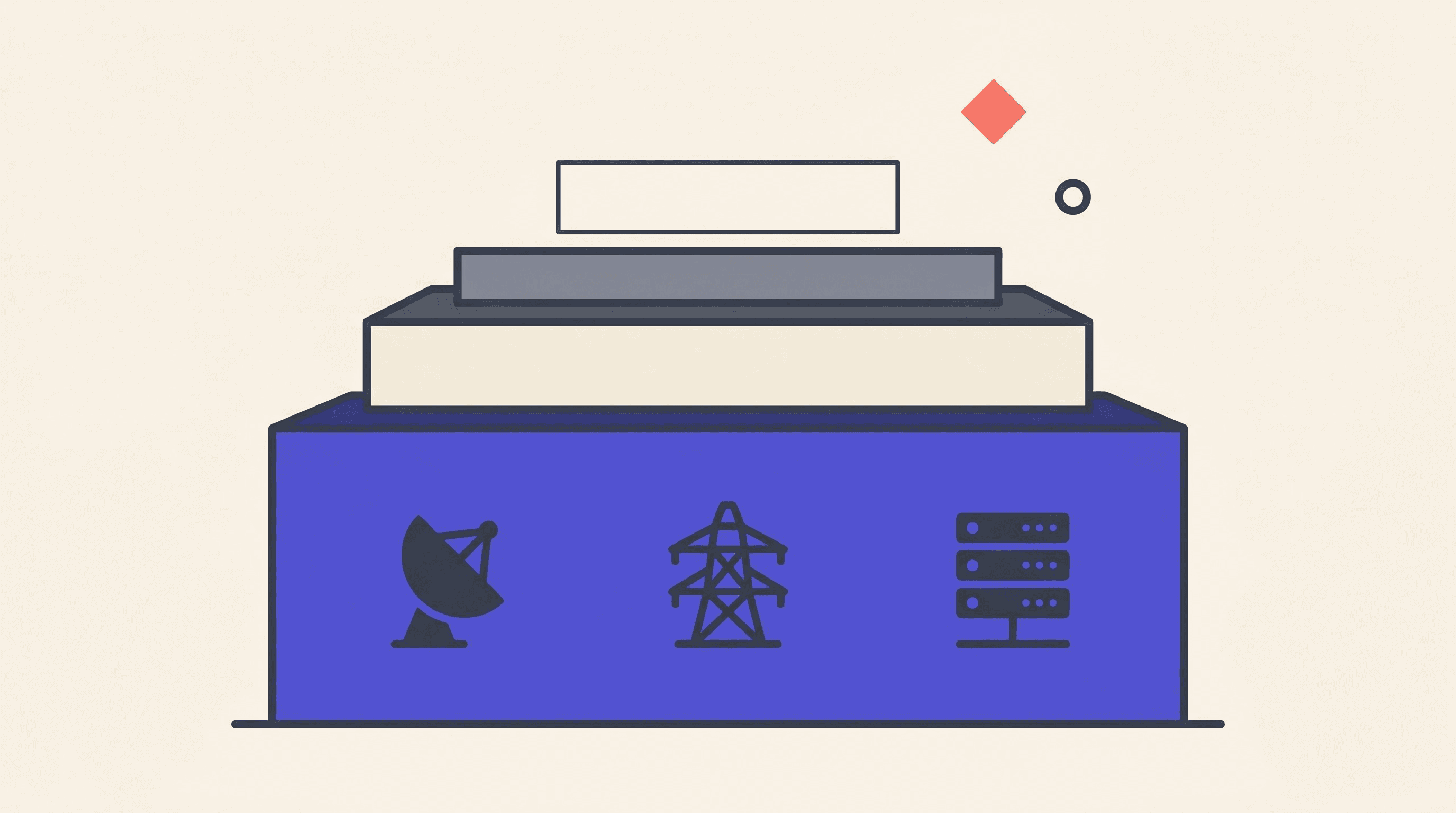
SpaceX filed its S-1 yesterday, a 250-plus-page prospectus making the explicit case that infrastructure, not software, decides the AI economy, and reframing the company as a vertically integrated compute, networking, and energy platform. The filing reports $18.7 billion in 2025 revenue, folds xAI into SpaceX's segment reporting, and reportedly targets a valuation of up to $1.75 trillion. The line the S-1 leads with: "the future of AI will be determined by the control of the physical stack."
Read that for what it is: a vendor making the case for its own valuation. But the implication for buyers is real regardless of whether SpaceX hits $1.75 trillion at the open: every frontier-AI contract a team signs in 2026 carries a compute-provider exposure that wasn't on the contract three years ago, and that exposure sits inside the vendor risk profile whether anyone priced it or not.
Yesterday's Echo covered Anthropic's $1.25 billion-per-month, $15 billion-per-year compute deal with SpaceX through 2029. That's the buyer-side translation of this S-1 thesis already running in production. If your team has a Claude Enterprise contract, you have a SpaceX dependency. The same logic runs for every frontier vendor: ChatGPT Enterprise carries an Azure dependency through OpenAI's Microsoft tie-in, Gemini carries Google's TPU stack, Bedrock-deployed models carry Trainium and AWS. Three years ago a model vendor was just a model vendor. Today every model-vendor contract carries a second-order infrastructure-provider exposure, and the S-1 is making the case that consolidation accelerates from here.
The argument the prospectus is actually making is structural: frontier models are commoditizable over a long-enough horizon, because every well-capitalized lab will eventually reach the same capability ceiling on the same benchmark, while compute supply isn't commoditizable on the same curve. Energy, networking, and chip fabrication don't compress on the same schedule as model performance. Margins, on this read, move toward whoever owns the bottleneck, and the bottleneck is the physical infrastructure. That's a coherent argument. It's also, conveniently, exactly the argument a launch-and-satellite company files to justify a $1.75 trillion valuation.
The steelman is the hyperscaler counter. Google, Microsoft, and AWS run vertically integrated compute stacks at full scale right now, with proven enterprise sales channels and customer footprints that didn't have to be invented from a satellite constellation. Google's TPU stack underwrites Gemini's unit economics, Microsoft's Azure underwrites OpenAI's, and Amazon's Trainium underwrites Bedrock. The integrated-infrastructure argument isn't unique to SpaceX. Whether the SpaceX terrestrial-plus-orbital stack actually beats the hyperscalers over the next decade is a question that can't be resolved in the next eighteen months, and buyers shouldn't try to.
The unresolved question for buyers isn't who wins the infrastructure war. It's whether the contract you signed turned that war into your war.
What to Do With This
Map every frontier-AI vendor in your stack to its primary compute provider, and treat compute-provider exposure as a contract clause to negotiate, not a footnote.
Three specific moves. First, in any new frontier-AI contract, ask for a clause requiring the vendor to disclose changes to its primary compute provider with 90 days' notice. Second, ask the vendor for a documented continuity plan if its primary compute provider experiences degraded service. Third, when evaluating two or more frontier vendors, include compute-provider concentration as a scored variable in the selection matrix. The vendors will not volunteer this. It has to be asked in writing.
Also on the Radar
Karpathy Joined Anthropic
Andrej Karpathy posted that he'd started at Anthropic this week. Pre-IPO talent flow into Anthropic's research bench at a moment when the lab needs to land the next frontier release on schedule. The signal isn't the hire; it's that senior talent is moving as if Anthropic's October window is fixed.
Cursor Composer 2.5 Matches Opus 4.7 on Coding Benchmarks
Cursor's Composer 2.5 shipped May 18 with reported parity to Opus 4.7 on coding benchmarks at a fraction of the per-task cost. The model-level gap to Claude Code closed at the IDE-native tier. The procurement question shifts from "which model is better" to "which workflow fits the team," which is a different evaluation and one the Atlas dossier covers in detail.
OpenAI's Model Disproved an 80-Year-Old Geometry Conjecture
OpenAI reported a general-purpose reasoning model disproved Paul Erdős's planar unit distance conjecture, an open question in discrete geometry since 1946. Low immediate procurement relevance. Worth flagging as the first credible signal that a general-purpose frontier model can produce novel mathematical results without math-specific scaffolding, which moves the "AI in research workflows" conversation from speculation to data point.
Share
Read Next
See all
Echo
Two Markets, One Vendor
Together AI's $800 million Series C confirms open-source inference on neoclouds has become a revenue-scale market running parallel to the closed-frontier labs.
Echo
Nineteen Days
Anthropic redeployed Fable 5 after a 19-day export suspension and disclosed that every frontier model it tested could produce the same vulnerabilities.

Echo
Science Ships
Anthropic shipped Claude Science and OpenAI published GeneBench-Pro on the same day, and science graduated from an AI use case to a product category at both labs.