When A Productivity Boom Feels Like Mass Layoffs
April 9, 2026
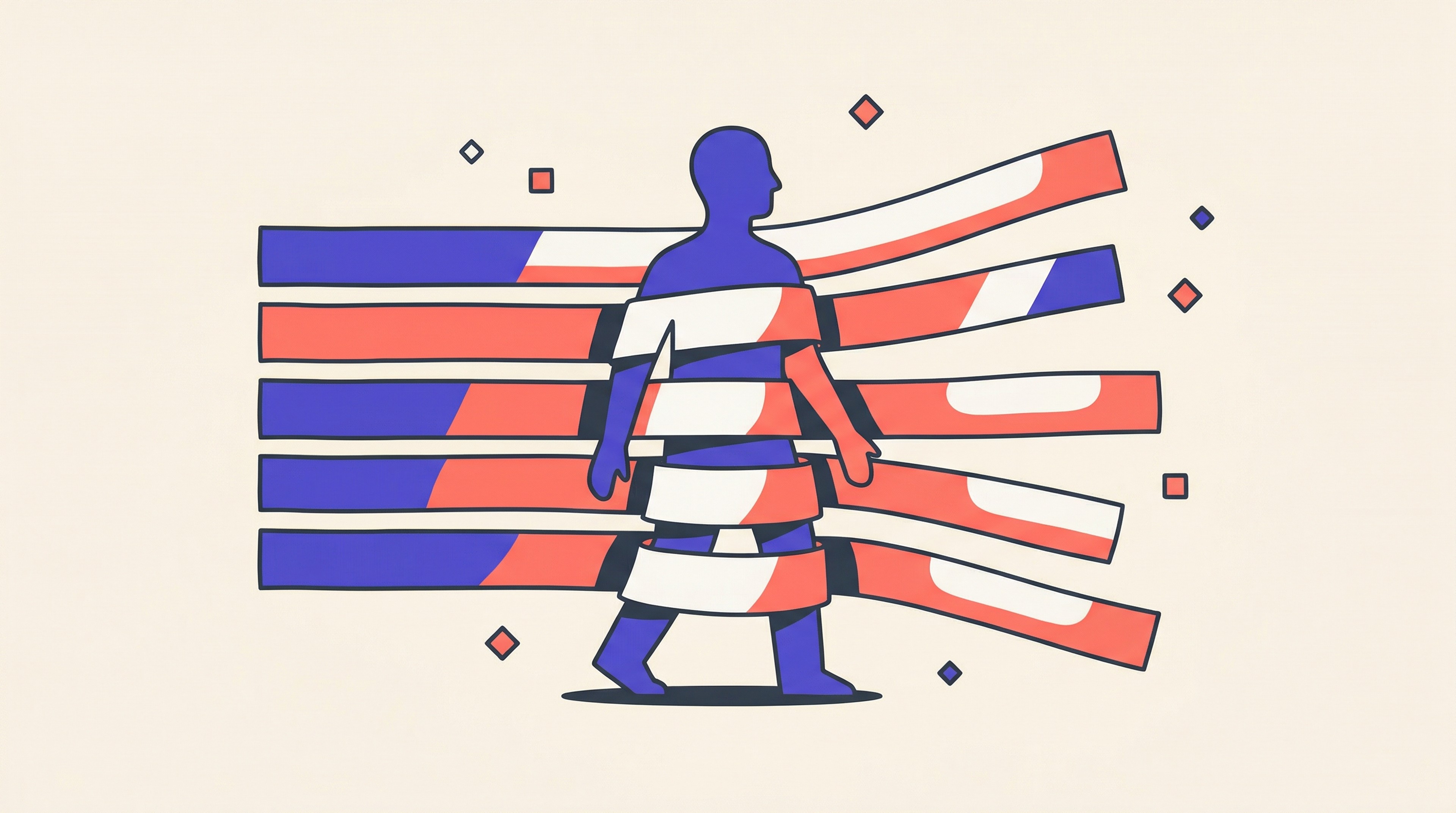
Imagine an AI boom that leaves 40% of people unemployed. Catastrophic.
Now imagine an AI boom that gives everyone a three‑day workweek. Utopian.
To a first approximation, they’re the same thing.
Whether 60% of people work full‑time or everyone works 60% time, the economy gets the same number of work hours. The difference between catastrophe and wonderland isn’t the math. It’s how we distribute the hours, the income, and the status that comes with them.
At first approximation, 40% unemployment and a 3-day week describe the same amount of work. If 100 people each work 5 days, that is 500 workdays. If 60 people work 5 days, that is 300. If 100 people work 3 days, that is also 300.
A 40% unemployment rate, however, concentrates the shock, while a 3-day week spreads it. One world strips a minority of income, bargaining power, routine, and status. The other keeps most people attached to work while turning part of the productivity gain into time. Same hours. Opposite moral experience.
Headcount and hours are not perfectly interchangeable though. Hiring costs, skill mismatch, and sector frictions make the real world messier. Still, the napkin math reveals where the true disagreement actually is.
The paradox hits hard because people use “job” as shorthand for 5 different variables at once: output, hours, income, identity, and social inclusion. When those come apart, language lags behind. “Unemployment” sounds like exclusion because it is exclusion. “Shorter week” sounds like freedom because the attachment survives.
This Is Old Wisdom
No, this way of thinking is not unprecedented.
John Keats called the relevant faculty “negative capability” in 1817: the ability to remain in uncertainty without forcing a fake resolution. Fitzgerald gave the modern magazine version in 1936 when he wrote that first-rate intelligence could hold opposed ideas in mind at once and still function. Bohr later popularized a version about “deep truths,” where the opposite may also carry truth. Different domains, same lesson: mature judgment can keep 2 valid frames in view without flattening one into a slogan.
AI and work demand exactly that kind of double vision. AI can make large parts of the economy more productive. AI can also hurt specific workers, age groups, and regions long before the aggregate data look dramatic. Both propositions can be true at the same time.
History Already Ran This Experiment
The long history of work in the United States points in one direction. Annual hours worked per person engaged fell from 3,096 in 1870 to 1,788.9 in 2023, about a 42% drop. BLS also notes that the average manufacturing workweek fell from 53 hours in 1900 to about 42 in 1999, while estimated unemployment was 5% in 1900 and 4.2% in 1999. A large decline in hours per worker can coexist with the absence of permanent mass unemployment.
That decline did not arrive by magic. It came through bargaining, law, politics, and managerial choice. Henry Ford moved to an 8-hour day in 1914, pairing shorter hours with a $5 minimum daily wage and arguing that better-paid, less-exhausted workers would be more productive and more able to buy the goods they made. In 1922 he announced the 5-day week, later implemented in 1926, and explicitly described the 40-hour week as a way to spread work to idle workers while preserving decent wages. Then the Fair Labor Standards Act of 1938 set a 40-hour maximum workweek for most manufacturing workers, phased in by 1940. Machines raised productivity. Institutions decided that part of the gain would show up as time.
Childhood lengthened because schooling replaced work for many children. NCES (National Center for Education Statistics) says school enrollment as a share of 5-to-17-year-olds rose from 64.7% in 1869-70 to 94.9% in 2019-20. BLS notes that after the Civil War, children as young as 10, and sometimes younger, routinely worked in factories, on farms, in stores, and in home industries.
Retirement lengthened because pensions and social insurance turned late life into a distinct stage instead of a scramble to work until collapse. The Social Security Administration says state old-age pensions were practically nonexistent before 1930. CDC data show U.S. life expectancy at birth at 47.3 years in 1900 and 79.0 in 2024, while a 65-year-old in 2023 could expect another 19.5 years on average. Much of what used to be labor time moved into school years and retirement years.
Even modern downturns offer a clean example. During the global financial crisis, Germany’s Kurzarbeit scheme subsidized firms to cut hours rather than cut people. The IMF says the program was instrumental in keeping employment stable; Germany was the only G7 country that did not experience an employment fall in 2009 despite GDP contracting by almost 6 percentage points, and about a third of the reduction in working time per employee came through Kurzarbeit. That is the 3-day-week logic in miniature: spread the hours shock, keep people attached to work, cushion incomes, and preserve the capacity to rebound. (IMF)
AI Brings The Same Choice Back
The current AI evidence points to transformation and uneven pressure more than immediate economy-wide collapse. The ILO’s 2025 update says 1 in 4 workers worldwide are in occupations with some degree of generative AI exposure, and that most jobs are more likely to be transformed than made redundant. Its refined global index, built from nearly 30,000 tasks, still finds clerical work most exposed, with some digitized professional and technical occupations growing more exposed as models improve. IMF staff make a similar two-sided point: AI can complement human work in many cases even as it threatens displacement in others.
At the macro level, the boom still looks more promised than delivered. OECD says labor productivity across OECD countries rose only 0.6% in 2023 and was expected to grow around 0.4% in 2024, with AI’s impact “not yet evident” in the productivity statistics. The ECB reports that employee AI use in the euro area rose from 26% in 2024 to 40% in 2025, and that 2 out of 3 surveyed firms say their employees use AI. Yet the ECB also says there is currently little evidence of a substantial aggregate employment effect in the euro area, and cites EU firm-level evidence of a 4% productivity gain from AI adoption with no adverse employment effect so far.
Under the surface, the pressure already looks lopsided. A World Bank paper using 285 million U.S. job postings finds that postings for occupations with above-median AI substitution scores fell 12% relative to less vulnerable occupations after ChatGPT’s launch, with sharper declines in entry-level and administrative roles. A Stanford-led study finds that workers aged 22 to 25 saw a 6% employment decline from late 2022 to September 2025 in the most AI-exposed occupations, while older workers in those occupations saw gains. Aggregate calm and local pain can coexist for a long time.
There is one more reason distribution belongs at the center of the story. Productivity gains have no automatic route into ordinary living standards. BLS tracks a long-running gap between labor productivity and real hourly compensation in the U.S. since 1973. OECD finds that in most OECD countries over the past 2 decades, aggregate labor productivity growth has decoupled from real median compensation growth, driven by lower labor shares and a falling median-to-average wage ratio. So even if AI is broadly productive, people will not automatically receive the dividend as pay or as time. Someone has to bargain, legislate, tax, or organize it into existence.
Mental Models That Help
Hours, Headcount, Income, And Status Are Different Variables. Most public arguments about work blur them together. They should be kept separate. A society can cut labor hours without cutting incomes, or preserve incomes while cutting headcount, or keep headcount steady while compressing wages. The policy problem becomes visible once those variables stop masquerading as one thing.
Jobs Are Bundles Of Tasks. AI usually enters through tasks, not through whole occupations vanishing overnight. That is why early damage often shows up first in clerical work, administrative support, and entry-level roles, while aggregate employment can still look stable. The task view also explains why the same tool can substitute for one worker and complement another.
Macro Calm Can Hide Micro Shock. Headline unemployment can stay low while a cohort gets boxed out. Young workers, junior white-collar staff, and routine cognitive roles may feel the squeeze first. The politics of AI will be shaped by those concentrated losses, even if the top-line numbers look manageable for years.
Productivity Needs A Transmission Mechanism. Higher productivity is raw material. Institutions turn it into something people can feel. The menu includes higher wages, lower prices, more profits, more public revenue, shorter standard hours, longer vacations, earlier retirement, or some ugly mix in which gains pool at the top while insecurity spreads below. The post-1973 productivity-pay gap shows why this mechanism matters.
Work-Sharing Has History. Ford’s shorter day, the 40-hour week, longer schooling, retirement systems, and Germany’s Kurzarbeit all show that societies can decide to spread a reduction in necessary labor across the population instead of concentrating it in layoffs. Shared leisure is not a law of nature. It is a settlement.
Where This Leaves The AI Debate
The strongest version of the optimistic case says AI will be a general-purpose technology, meaning one that spreads across many sectors and tasks rather than staying trapped in one niche. The strongest version of the pessimistic case says those gains may arrive in ways that sideline specific workers and transfer bargaining power upward. History gives reasons to take both sides seriously.
That is why wisdom here means holding 2 propositions at once. Society may need fewer hours of human labor. People can still end up better off. Society may get richer. Many workers can still get hurt. The gap between those outcomes is where politics, institutions, and social norms enter.
An AI dividend could take many forms. Universal basic income is one. Shorter standard weeks, more paid leave, wage insurance, payroll subsidies, portable benefits, public investment in care and education, and work-sharing rules are others.
The form matters less than the principle: when a general-purpose technology saves labor, the savings have to go somewhere.